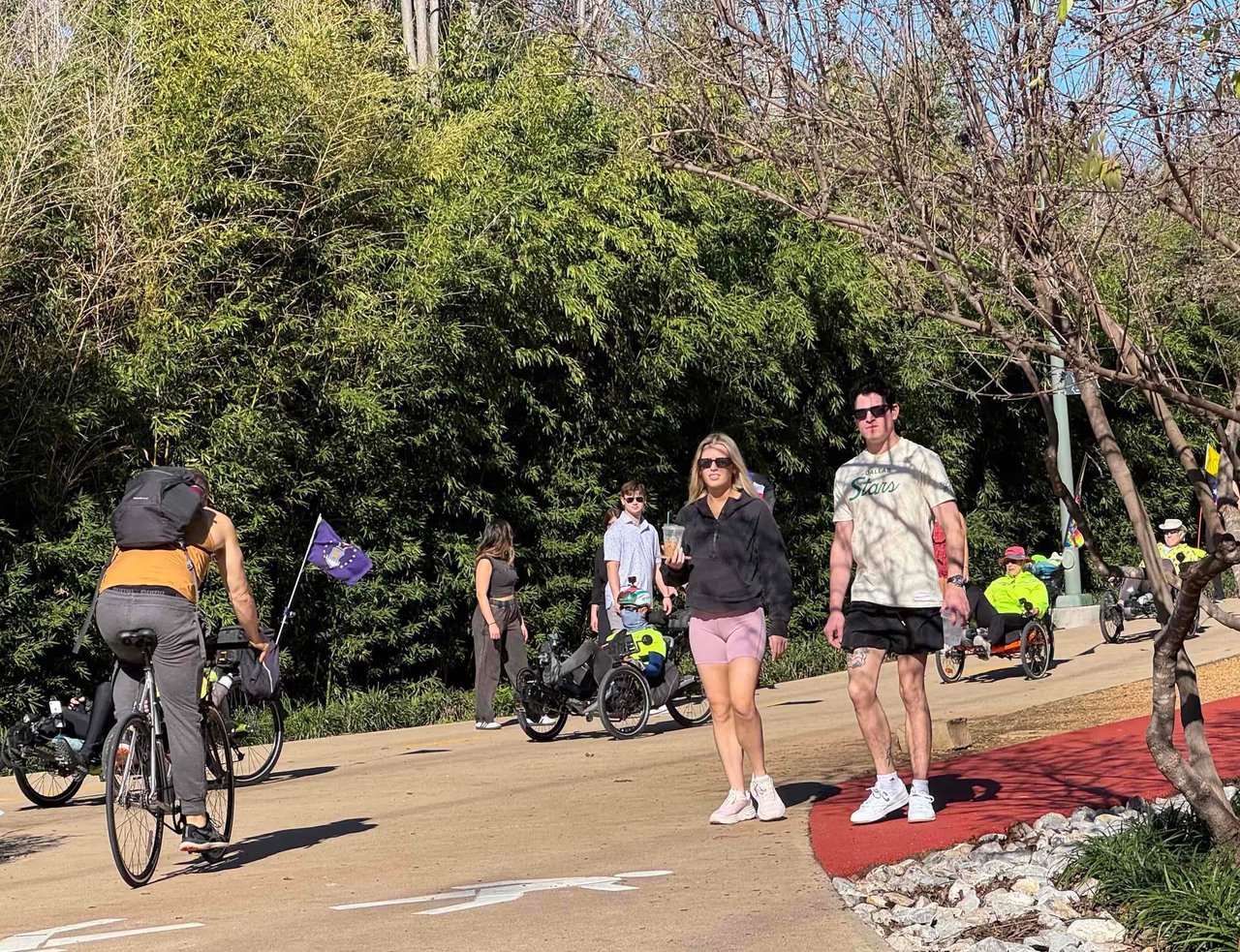
Walk north from Knox Street on the Katy Trail on any given morning and you'll notice the shift before you can name it. The path stays smooth, the shade holds, joggers keep passing on the left just like the signage asks. Then somewhere past the Knox crossing, headed toward Harvard, the landscaping thins out. What used to be intentional planting becomes mowed grass, weeds, and loose rock. Some of the cedar trees along this stretch are dying. The soft-surface running path gets slick where silt has built up, and more than one regular has caught a foot on the eroded edge.
This stretch runs closest to Highland Park's southeast corner. A capital project is now in construction to improve it.
The Project and Its Timeline
The Friends of the Katy Trail's 2017 Master Plan called for exactly what this segment needs: native grasses, wildflowers, and denser tree cover between Knox and Harvard. But the nonprofit's Complete the Trail Campaign, which ran from 2018 through 2020, focused its improvements on sections farther south, closer to Uptown and the American Airlines Center. The Knox-to-Harvard stretch, which functions as Highland Park's unofficial front porch onto the trail, was not included in those improvements.
That changes this year. A $3 million capital project, funded through a combination of the City of Dallas's 2024 bond program and private fundraising, is now in its construction phase after a design period that ran through 2025.
Detail | Figure |
|---|---|
Total project cost | $3 million |
City of Dallas bond match | $1 million |
Private fundraising goal | $2 million |
Private dollars raised as of May 2025 | $1.5 million+ |
Project phase as of August 2026 | Construction |
The list of donors reads like a roll call of Dallas philanthropy: Lyda Hill Philanthropies made the first major grant, followed by gifts from the Perot Family, Steven Rayl and Scot Presley, the Budd Family Foundation, Uptown Dallas Inc., the Eugene McDermott Foundation, and the Richard King Mellon Foundation. Those contributions support the planned improvements to the Knox-to-Harvard stretch.
A New Front Door, Literally
The centerpiece of the construction work is a brand-new trail entrance at Fairmount and Maple, officially listed on the City of Dallas bond project dashboard as the Fairmount/Maple entrance serving the Knox-to-Harvard segment. For Highland Park residents who currently have to walk south to Knox or north past Harvard to find a formal access point, this closes a real gap. It's a direct answer to years of trail users treating this stretch as a pass-through rather than a place to enter.
The rest of the scope matches what the master plan called for: replacing the dying cedars with tree varieties better suited to the site, correcting the erosion that's been undermining the soft-surface path, and finally installing the native grasses and wildflowers the 2017 plan envisioned. None of it is glamorous. All of it explains why, if you've walked this stretch in the past year, you've probably noticed orange fencing, equipment staging, or a temporary reroute onto the paved side of the path. That's expected through the remainder of construction, and it's part of the work to improve this section of the trail.
The Art Is Coming Right Behind the Dirt Work
Here's where the timing gets interesting. In March 2026, Friends of the Katy Trail announced the KTX Biennial, described by the organization as Texas's first biennial dedicated entirely to public art. The inaugural edition opens in spring 2027, timed deliberately to coincide with the Dallas Art Fair that April, and it will run the length of the trail through Uptown, Knox, and Highland Park.
The person curating it is Jovanna Venegas, currently a curator at SculptureCenter in New York, who spent six years at the San Francisco Museum of Modern Art before that and served as a curatorial advisor for the 2022 Whitney Biennial's work on the U.S./Mexico border region. Amy Bean, the Friends of the Katy Trail's executive director, and Amanda Dillard Shufeldt, the trail's art director, are the ones who built the program from a smaller 2021 pilot that already put work by artists like Iván Argote, Eddie Martinez, Will Boone, Nic Nicosia, and Carolyn Salas along the path. The biennial is the formalized, much larger version of that experiment.
In ARTnews, Dillard Shufeldt said, "We thought that the most beloved trail in the city of Dallas, the Katy Trail, made a lot of sense as the location for a public art program."
That's Dillard Shufeldt's own explanation for why a running path became a gallery in the first place. Because Dallas caps temporary public art installations at 18 months, the biennial format wasn't really optional. It's a structural response to city policy as much as a creative choice, which is part of why the works will rotate rather than sit permanently.
What this means for the Knox-to-Harvard segment specifically: it will finish construction as one of the trail's newest, most deliberately landscaped stretches right around the time the first biennial installations start going in. The result will be a refreshed stretch with new public art as part of the trail-wide program.
What Changes for Someone Who Already Walks Here
If you already use this stretch, whether for a dog walk, a run before work, or the shortcut over to Highland Park Village, here's the practical version of what's ahead:
- Expect intermittent reroutes and construction fencing through the remainder of 2026 as the entrance and landscaping work finishes.
- The new Fairmount/Maple entrance gives this part of Highland Park a formal access point that hasn't existed before.
- The dying cedars will be replaced with more resilient tree varieties, and the erosion-prone soft-surface path should stop being a slip hazard.
- Starting in spring 2027, expect to see contemporary sculpture and installation work appear along the corridor, with pieces rotating roughly every 18 months.
- If you're timing a visit around the art, the Dallas Art Fair's April dates are the anchor point for the biennial's public debut.
None of this happens in isolation. Friends of the Katy Trail's own figures show trail visits jumped from 2 million in 2022 to 4 million in 2024, a doubling in two years. Add in the Loop Dallas project, the city's plan to eventually connect 50 miles of trails across Dallas into one continuous system, and the demand curve on this corridor only points one direction. The stretch behind Highland Park is being rebuilt as trail visits increase.
For residents who've watched this half-mile change over time, the story is broader than landscaping: construction and a new public-art program are both coming to the Katy Trail near Highland Park.
If you're the kind of person who notices when your neighborhood changes before the rest of the city catches on, that instinct is worth something beyond a good walk. The team at Torelli Properties Group spends as much time tracking what's happening on the ground in Highland Park as we do tracking what's happening on a closing statement. When you're ready to talk about what any of this means for your own address, we're here for that conversation too.